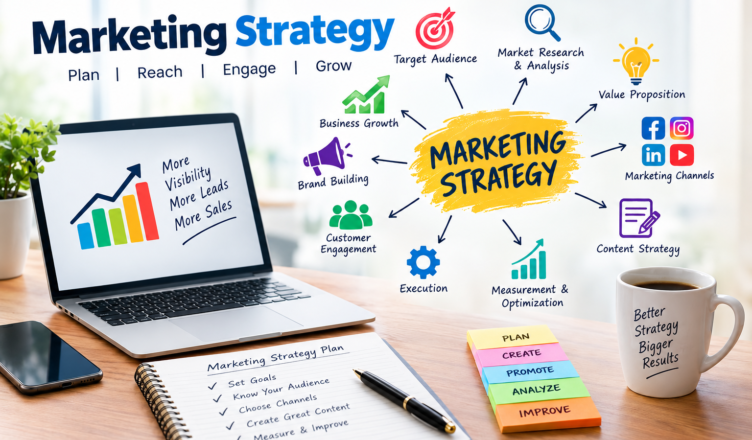
Marketing Strategy: A Complete Guide to Building a Successful Marketing Strategy
In today’s highly competitive digital marketplace, having a clear marketing strategy is essential for businesses that want to attract customers, build a recognizable brand, and generate sustainable growth. Whether you are running a startup, managing an established company, or working as a digital marketing professional, your ability to create and execute an effective marketing strategy can significantly influence your business results.
A successful marketing strategy is more than simply promoting products or services. It involves understanding your target audience, analyzing competitors, identifying market opportunities, selecting the right marketing channels, creating valuable content, and measuring performance. When these elements work together, businesses can create a consistent customer journey from awareness to conversion and retention.
This guide explains how to develop a practical marketing strategy, the key components involved, common mistakes to avoid, and how businesses can adapt their approach to changing customer behavior.
What Is a Marketing Strategy?
A marketing strategy is a structured plan that explains how a business will reach its target customers, communicate its value proposition, promote its products or services, and achieve specific marketing and business objectives.
Instead of randomly publishing content, running advertisements, or posting on social media, businesses use a marketing strategy to make their activities purposeful and measurable.
A strong plan typically answers several important questions:
- Who are your ideal customers?
- What problems are they trying to solve?
- What makes your product or service different?
- Where does your audience spend time online?
- What marketing channels should you use?
- What type of content should you create?
- How will you generate leads and sales?
- Which metrics will determine success?
The answers to these questions provide the foundation for an effective marketing strategy.
Why Is a Marketing Strategy Important?
Without a clear plan, businesses often waste money and resources on activities that do not contribute directly to their objectives. A well-developed marketing strategy provides direction and helps teams prioritize their efforts.
One of the biggest benefits is consistency. When a business has a documented marketing strategy, its website, social media accounts, advertisements, email campaigns, and sales materials can communicate a consistent message.
A strategic approach also helps businesses understand their customers more deeply. By analyzing customer behavior, preferences, pain points, and purchasing patterns, marketers can create campaigns that are more relevant.
Another advantage is better resource allocation. Instead of investing equally in every channel, businesses can identify the platforms and campaigns that produce the strongest results.
Ultimately, an effective marketing strategy connects marketing activity with measurable business outcomes.
Start With Clear Marketing Objectives
Before selecting channels or creating campaigns, define what you want to accomplish. Your marketing strategy should begin with specific and measurable objectives.
For example, a business might want to:
- Increase organic website traffic
- Generate more qualified leads
- Increase online sales
- Improve brand awareness
- Increase customer retention
- Enter a new geographic market
- Build an email subscriber base
- Improve conversion rates
Objectives should ideally follow the SMART framework: specific, measurable, achievable, relevant, and time-bound.
For example, instead of saying, “We want more traffic,” a company could establish an objective such as increasing qualified organic traffic by a specific percentage within six months.
Clear objectives make it easier to evaluate whether your marketing strategy is working.
Understand Your Target Audience
A successful marketing strategy starts with the customer rather than the product.
Businesses need to understand who they are trying to reach and why those people would purchase their products or services.
Audience research can include:
- Demographic information
- Geographic location
- Purchasing behavior
- Professional background
- Interests
- Online behavior
- Pain points
- Buying motivations
- Common objections
- Search behavior
Creating detailed buyer personas can help marketing teams visualize their ideal customers.
However, modern marketers should avoid relying solely on assumptions. Customer interviews, surveys, analytics, CRM data, search data, and sales-team feedback can provide valuable insights.
The better you understand your audience, the easier it becomes to develop a relevant marketing strategy.
Analyze Your Competitors
Competitive analysis is another important component of a strong marketing strategy.
Your competitors can provide useful information about the market, customer expectations, pricing, content opportunities, advertising approaches, and potential gaps.
Analyze competitors across several areas:
- Website experience
- SEO visibility
- Content strategy
- Social media presence
- Paid advertising
- Email marketing
- Product positioning
- Customer reviews
- Backlink profiles
- Offers and promotions
The goal is not simply to copy competitors. Instead, identify opportunities to differentiate your business.
For example, if competitors focus heavily on short-form content, you might develop comprehensive educational resources. If competitors target broad keywords, you might focus on specific high-intent search queries.
This type of analysis helps make your marketing strategy more competitive.
Develop a Strong Value Proposition
Your value proposition explains why customers should choose your business instead of an alternative.
A strong value proposition should communicate:
- What you offer
- Who you serve
- What problem you solve
- What makes your solution different
- What benefit customers receive
For example, instead of saying, “We provide digital marketing services,” a company could communicate a more specific benefit related to measurable organic growth, qualified leads, or industry expertise.
Your value proposition should appear consistently throughout your marketing strategy, including your website, advertisements, landing pages, social media profiles, and sales communication.
Choose the Right Marketing Channels
Not every business needs to be active on every platform.
An effective marketing strategy prioritizes channels based on audience behavior, business objectives, available resources, and expected return.
Common marketing channels include:
Search Engine Optimization
SEO helps businesses attract people who are actively searching for information, products, or services.
A strong SEO program can include technical optimization, keyword research, content development, internal linking, digital PR, local SEO, and authority building.
Content Marketing
Content marketing involves creating useful resources that educate, inform, or entertain your audience.
Examples include:
- Blog posts
- Guides
- Case studies
- Whitepapers
- Videos
- Webinars
- Research reports
- Infographics
High-quality content can support multiple stages of the customer journey.
Social Media Marketing
Social media can help businesses build communities, distribute content, demonstrate expertise, and interact directly with customers.
The best platform depends on where the target audience is most active.
Email Marketing
Email remains useful for nurturing leads, retaining customers, distributing content, and promoting products or services.
A well-segmented email program can make communication more relevant and personalized.
Paid Advertising
Paid search, social advertising, display advertising, and other paid channels can provide immediate visibility.
However, campaigns should be managed carefully and evaluated based on business outcomes rather than impressions alone.
The right combination of channels will depend on your overall marketing strategy.
Build a Content Strategy
Content is one of the most important assets in modern digital marketing.
A content-focused marketing strategy should begin with audience needs and search intent rather than simply generating a large number of articles.
Content can target different stages of the customer journey.
Awareness Content
This content introduces a problem or topic to potential customers.
Examples include:
- Educational blog posts
- Beginner guides
- Industry trends
- How-to articles
Consideration Content
At this stage, prospects are evaluating possible solutions.
Examples include:
- Comparisons
- Case studies
- Expert guides
- Product explainers
- Webinars
Decision Content
Decision-stage content helps prospects take action.
Examples include:
- Product pages
- Pricing pages
- Demonstrations
- Testimonials
- Customer success stories
Mapping content to the buyer journey makes your marketing strategy more effective.
Use SEO as a Long-Term Growth Channel
SEO should be integrated into your broader marketing strategy rather than treated as a separate activity.
Keyword research helps identify what potential customers are searching for. However, modern SEO requires more than inserting keywords into articles.
Businesses should focus on search intent, content usefulness, topical coverage, technical performance, internal linking, website architecture, and overall user experience.
For example, if someone searches for “best accounting software for small businesses,” an article should provide genuinely useful information that addresses the user’s decision-making needs.
A successful marketing strategy uses SEO to connect valuable content with relevant search demand.
Build a Strong Brand
Brand building should be an important part of your marketing strategy.
A strong brand can improve recognition, trust, customer loyalty, and differentiation.
Brand development includes:
- Visual identity
- Brand voice
- Messaging
- Positioning
- Customer experience
- Thought leadership
- Reputation management
Consistency matters. Customers should receive a recognizable experience whether they encounter your business through Google, LinkedIn, YouTube, email, or your website.
Create a Conversion-Focused Website
Driving traffic is only one part of a successful marketing strategy.
If your website does not convert visitors into leads or customers, increasing traffic may not produce meaningful business growth.
Review your website for:
- Clear headlines
- Strong value propositions
- Simple navigation
- Relevant calls to action
- Fast loading times
- Mobile usability
- Trust signals
- Customer testimonials
- Clear contact information
- Easy-to-use forms
Conversion rate optimization can help businesses generate more value from existing traffic.
Measure the Right Metrics
Measurement is essential because your marketing strategy should be based on evidence rather than assumptions.
Depending on your objectives, useful metrics may include:
- Organic traffic
- Qualified leads
- Conversion rate
- Customer acquisition cost
- Return on advertising spend
- Revenue
- Customer lifetime value
- Email engagement
- Engagement rate
- Search visibility
- Cost per lead
Avoid focusing exclusively on vanity metrics.
For example, a campaign may generate thousands of impressions but very few qualified leads. Another campaign might receive less traffic but generate significantly more revenue.
The most useful metrics are those connected to actual business objectives.
Test, Learn, and Improve
A strong marketing strategy should never remain static.
Customer behavior changes. Competitors launch new campaigns. Search engines evolve. Social platforms introduce new features. Economic conditions can influence purchasing decisions.
For this reason, marketers should continuously test their assumptions.
You can experiment with:
- Headlines
- Landing pages
- Calls to action
- Ad creatives
- Content formats
- Email subject lines
- Offers
- Audience segments
- Keywords
- Publishing frequency
Use performance data to determine what should be improved, expanded, or discontinued.
Common Marketing Strategy Mistakes
Even experienced marketing teams can make mistakes.
1. Targeting Everyone
Trying to appeal to everyone often produces weak messaging. A focused audience usually makes communication more relevant.
2. Focusing Only on Traffic
Traffic is useful, but it is not the ultimate objective for most businesses. Leads, customers, and revenue are usually more meaningful.
3. Publishing Content Without a Purpose
Creating hundreds of articles without understanding search intent or business objectives can waste resources.
4. Ignoring Existing Customers
Acquiring customers is important, but retention and repeat purchases can also contribute significantly to growth.
5. Not Measuring ROI
Without measurement, it becomes difficult to determine which activities deserve additional investment.
6. Changing Direction Too Quickly
Some channels, particularly SEO and content marketing, can require time before meaningful results appear. Constantly changing direction can prevent campaigns from reaching their potential.
Avoiding these mistakes can make your marketing strategy more focused and sustainable.
How AI Is Changing Marketing
Artificial intelligence is becoming increasingly important across the marketing industry.
Marketers can use AI tools for:
- Research
- Content ideation
- Data analysis
- Customer segmentation
- Personalization
- Automation
- Competitive analysis
- Creative experimentation
However, AI should support human expertise rather than replace strategic thinking.
A strong marketing strategy combines automation and technology with original insights, customer understanding, creativity, and quality control.
Businesses should also ensure that AI-generated content provides genuine value rather than simply increasing publishing volume.
Build an Omnichannel Customer Journey
Customers rarely interact with a company through a single channel.
A potential customer might discover a brand through Google, watch a video, visit the website, read reviews, subscribe to an email list, and eventually purchase after seeing a social media post.
An integrated marketing strategy connects these touchpoints.
The goal is not necessarily to repeat the same message everywhere. Instead, each channel should have a clear role within the overall customer journey.
For example:
- SEO can generate discovery.
- Content can educate prospects.
- Social media can build engagement.
- Email can nurture leads.
- Sales can handle high-intent prospects.
- Customer marketing can encourage retention.
Develop a 90-Day Marketing Strategy Plan
Businesses that want to improve their marketing can begin with a structured 90-day approach.
Days 1–30: Research and Planning
Start by analyzing your audience, competitors, website, existing campaigns, content, SEO performance, and customer journey.
Define your primary objectives and identify the biggest opportunities.
Days 31–60: Implementation
Begin executing your priorities.
This might include:
- Technical SEO improvements
Marketing Strategy - New landing pages
- Content creation
- Email campaigns
- Paid advertising
- Social media campaigns
- Conversion optimization
Focus on activities that directly support your objectives.
Days 61–90: Measurement and Optimization
Review performance data.
Identify what generated meaningful results and what did not.
Improve successful campaigns, test new approaches, and remove activities that consistently fail to contribute to your objectives.
This creates a continuous improvement cycle for your marketing strategy.
The Future of Marketing
The future of marketing will likely involve greater personalization, automation, AI-assisted workflows, first-party data, search evolution, and increasingly integrated customer experiences.
However, the fundamentals remain important.
Businesses still need to understand their customers, solve real problems, communicate clear value, and deliver positive experiences.
Technology can make marketing faster and more scalable, but technology alone does not create a successful brand.
The most effective marketing strategy will combine data, creativity, technology, customer insights, and continuous experimentation.
Final Thoughts
Creating a successful marketing strategy requires more than selecting a few advertising platforms or publishing regular social media posts. It requires a clear understanding of customers, competitors, business objectives, positioning, content, distribution, conversion, and measurement.
The strongest strategies are flexible enough to adapt to changing markets while remaining focused on measurable business goals.
Whether you are a startup looking for your first customers or an established organization trying to increase market share, the fundamentals remain similar: understand your audience, create meaningful value, reach customers through relevant channels, measure the results, and continuously improve.
A well-planned marketing strategy can provide the structure businesses need to turn marketing activities into sustainable growth. Instead of chasing every new trend, businesses should build a strong strategic foundation and then use emerging technologies and channels to improve their execution.
For marketers, the biggest opportunity is to combine experience with experimentation. Data can reveal what is happening, customer research can explain why it is happening, and strategic thinking can determine what to do next.
That combination is what turns a collection of marketing activities into a genuine growth engine.
2 thoughts on “Marketing Strategy”