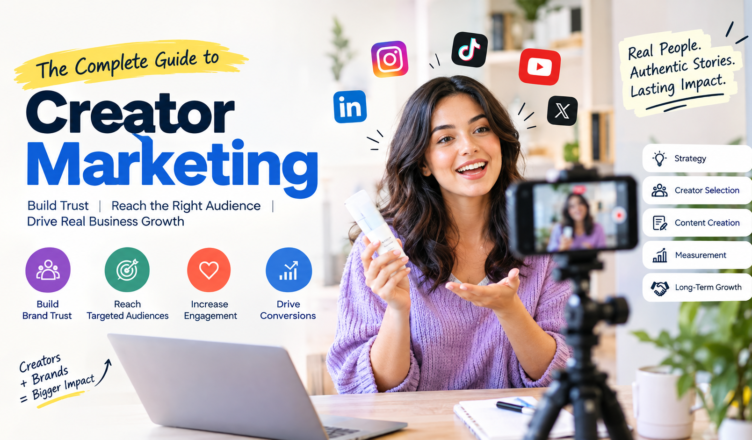
Creator Marketing: The Complete Guide to Building Brand Growth Through Creators
Introduction
Brands are competing for attention in a digital environment where audiences are increasingly selective about what they watch, read, and trust. Traditional advertising can still create awareness, but modern consumers often want recommendations that feel authentic and relevant to their interests. This shift has created a powerful opportunity for brands to collaborate with content creators who already have engaged communities.
Creator Marketing has become an important part of modern digital strategy because it combines storytelling, community, social proof, and distribution. Instead of communicating only through a brand account, businesses can work with creators who understand the language, expectations, and interests of a specific audience.
For marketers, the opportunity goes beyond getting a creator to publish a sponsored post. A successful strategy requires careful research, creator selection, campaign planning, creative freedom, measurement, and long-term relationship building. When these elements work together, creator partnerships can support awareness, engagement, traffic, leads, and sales.
This guide explains how brands can build an effective creator-led strategy, how to select the right partners, what mistakes to avoid, and how to measure business results.
What Is Creator Marketing?
Creator Marketing is a strategy in which brands collaborate with independent content creators to communicate products, services, ideas, or brand stories to an audience. Creators may publish content on platforms such as Instagram, YouTube, TikTok, LinkedIn, podcasts, blogs, newsletters, or other communities.
The creator’s value is not simply the number of followers they have. Their real value often comes from the relationship they have built with their audience. A smaller creator with a highly relevant and engaged community can sometimes be more useful for a campaign than a large account with broad but less relevant reach.
A creator partnership can take many forms. It may include product reviews, tutorials, demonstrations, educational videos, interviews, livestreams, testimonials, affiliate campaigns, event coverage, or long-term ambassador programs.
The most effective campaigns start with a clear business objective. A brand should know whether it wants to increase awareness, introduce a product, generate website traffic, collect leads, support sales, build a community, or strengthen brand credibility.
Why Creator Marketing Matters
The growth of social platforms has changed how people discover brands. Consumers can now find products through videos, recommendations, communities, reviews, and conversations rather than relying only on traditional search or advertisements.
Creator Marketing helps brands participate in these conversations through people who already have an established communication style and audience. A creator can demonstrate how a product fits into real life, explain a complicated service, compare alternatives, or tell a story in a way that feels native to the platform.
Another advantage is content production. Instead of depending entirely on an internal marketing team, brands can collaborate with creators who understand how to produce platform-specific content. This can give campaigns a larger creative range while allowing the brand to learn what resonates with different audience segments.
However, the strategy should not be treated as a shortcut to instant sales. Results depend on audience fit, creative quality, offer strength, distribution, timing, and measurement. A creator with a huge audience is not automatically the right partner.
Creator Marketing vs. Traditional Influencer Marketing
The terms creator and influencer are often used interchangeably, but there can be an important difference in how brands approach them.
Influencer campaigns have historically focused heavily on audience size, reach, and promotional visibility. Creator-led campaigns often place greater emphasis on the creator’s ability to produce original content, build communities, educate audiences, and tell stories.
This distinction matters because a creator can provide value even when the primary goal is not direct promotion. A skilled creator may produce a tutorial, review, podcast episode, case study, or educational video that continues generating attention after the campaign period ends.
For brands, the practical lesson is simple: evaluate what the person can create and how well their audience matches the business, rather than judging the partnership only by follower count.
How to Choose the Right Creator
Creator Marketing works best when there is a strong match between the brand, creator, content, and audience. Before approaching potential partners, define the audience you want to reach.
Start by identifying demographics, interests, buying behavior, location, professional background, pain points, and preferred content formats. Then search for creators whose audiences overlap with those characteristics.
Review the creator’s recent content rather than looking only at their profile summary. Examine the quality of comments, the consistency of engagement, the subjects they discuss, and how their audience responds to recommendations.
Look for signs of genuine community interaction. Thousands of views do not necessarily indicate strong influence. A creator who regularly receives meaningful questions, discussions, and recommendations may have a healthier audience relationship.
Also review previous brand collaborations. If every post looks like a generic advertisement, the creator may not be the right fit. Strong partners usually know how to integrate commercial messages into content without losing their authentic voice.
Micro, Mid-Tier, and Large Creators
A common mistake is assuming that bigger audiences always produce better campaign results. In practice, different creator sizes can serve different objectives.
Micro-creators often have smaller communities but can provide strong niche relevance and close audience relationships. They may be useful for local campaigns, specialized products, community building, and targeted testing.
Mid-tier creators can offer a balance between reach and audience specificity. They may be suitable when a brand wants meaningful scale without moving entirely into mass-market communication.
Large creators and celebrities can provide significant awareness and broad visibility. They may be appropriate for major launches or campaigns where reach is a central objective.
A smart Creator Marketing strategy can combine multiple tiers. A brand might test messaging with smaller creators, identify winning creative concepts, and then expand the strongest ideas through larger partners and paid media.
Building a Creator Campaign Strategy
A campaign should begin with a documented brief. The brief should explain the business objective, target audience, key message, deliverables, timeline, mandatory brand requirements, disclosure expectations, and measurement plan.
At the same time, brands should avoid controlling every sentence or visual. Creators understand their audience better than most brands do. Giving them reasonable creative freedom can help content feel natural and platform appropriate.
Set clear boundaries rather than writing an overly restrictive script. For example, provide product facts that must be accurate, claims that cannot be made, brand assets that should be used, and legal requirements that must be followed.
Then allow the creator to decide how the story should be presented. This balance between brand consistency and creator authenticity is one of the most important elements of successful campaigns.
Creating Content That Performs
Creator Marketing should be treated as a content strategy, not simply a media-buying exercise.
High-performing creator content usually gives the audience something useful, interesting, entertaining, educational, or emotionally relevant. A product mention should support the story rather than become the entire story.
For example, a fitness creator could demonstrate a complete workout while naturally using a relevant product. A technology creator could solve a common problem and introduce software as part of the solution. A business creator could explain a complicated concept and use a brand’s service as a practical example.
Brands should also consider content repurposing. With appropriate rights and permissions, strong creator assets can potentially be adapted for paid social advertising, website content, email campaigns, landing pages, product pages, or sales enablement.
Creator Marketing and SEO
Creator partnerships can also contribute to broader digital visibility. While social engagement itself should not automatically be treated as a direct ranking factor, creator campaigns can generate content, discussions, branded searches, links, mentions, and referral traffic.
A creator may publish a detailed review that ranks in search results. A YouTube video may appear for product-related queries. A podcast interview may introduce the brand to a new audience. A creator’s website or newsletter may send qualified referral traffic.
For SEO teams, the opportunity is to connect creator campaigns with search intent. Identify questions audiences already ask, then collaborate with creators who can answer those questions naturally.
The strongest approach is not to force keywords into creator content. Instead, build useful content around topics that audiences genuinely search for and discuss.
Measuring Creator Marketing Performance
Measurement should go beyond likes and follower counts. Those metrics can provide useful context, but they do not necessarily demonstrate business impact.
Awareness campaigns may focus on reach, impressions, video views, completion rates, audience growth, and branded search activity.
Engagement campaigns can examine comments, shares, saves, replies, and meaningful audience interactions.
Traffic campaigns can measure clicks, sessions, landing-page engagement, and assisted conversions. Sales-focused campaigns can use unique discount codes, affiliate links, UTM parameters, referral tracking, and conversion data.
A useful measurement framework separates three levels: exposure, engagement, and business outcomes. This helps marketers understand whether a campaign generated visibility, meaningful interaction, and measurable commercial value.
Creator Marketing becomes much easier to optimize when every partnership has a defined measurement framework before content goes live.
Calculating ROI
Return on investment should be evaluated according to the campaign objective. If the goal is direct sales, calculate revenue and contribution margin against total campaign costs.
If the goal is awareness, direct revenue may not be the immediate measurement. In that situation, marketers can examine reach, qualified impressions, video completion, branded search changes, audience growth, or other agreed awareness indicators.
Campaign costs should include creator fees, product costs, agency fees, production expenses, paid amplification, platform costs, and internal resources when relevant.
Over time, compare creators and creative formats using consistent metrics. This creates a performance database that can inform future campaign decisions.
Common Mistakes to Avoid
One of the biggest mistakes in Creator Marketing is selecting partners based only on follower count. Audience relevance and engagement quality are usually more informative than a single vanity metric.
Another mistake is giving creators overly restrictive instructions. If a brand dictates every word, the final content may feel unnatural.
Failing to disclose commercial relationships can also create legal, regulatory, and trust issues. Brands should understand the advertising disclosure requirements that apply to their market and platform.
Poor tracking is another common problem. If links, discount codes, landing pages, or campaign identifiers are not set up correctly, it becomes difficult to determine which partnerships produced results.
Finally, treating creators as one-time media placements can limit long-term value. Strong relationships can create a library of content, recurring campaigns, product feedback, and brand advocacy.
Building Long-Term Creator Relationships
The strongest Creator Marketing programs often move beyond individual campaigns. Instead of repeatedly searching for new partners, brands can identify creators who consistently produce quality results and build long-term relationships with them.
Long-term partnerships allow creators to understand the brand more deeply. Their recommendations can become more credible because the audience sees a continuing relationship rather than a single sponsored post.
Brands can create ambassador programs, recurring content series, product development feedback groups, affiliate partnerships, event collaborations, and exclusive launches.
Creators can also provide valuable market intelligence. They hear questions from their audiences every day and may identify objections, trends, language, and product needs that traditional research misses.
The Role of Data and AI
Data can make creator selection and campaign optimization more systematic. Marketers can analyze audience demographics, engagement patterns, content performance, referral traffic, conversions, and historical campaign results.
AI tools can assist with research, content analysis, topic discovery, competitor monitoring, reporting, and campaign organization. However, automation should not replace human judgment.
Authenticity remains important because creator partnerships depend on trust. A spreadsheet can identify a potentially relevant creator, but a marketer still needs to evaluate the person’s content, reputation, audience relationship, and brand fit.
The future will likely involve a combination of technology and human decision-making. Data can improve efficiency, while creators provide the human storytelling that audiences recognize and value.
A Practical 90-Day Plan
During the first 30 days, define the audience, objectives, budget, measurement framework, and creator criteria. Build a shortlist and conduct detailed content and audience research.
During days 31 to 60, contact selected creators, negotiate deliverables, establish tracking, finalize briefs, and begin producing content. Test different creative approaches where possible.
During days 61 to 90, analyze results, identify the strongest content patterns, amplify successful assets where appropriate, and document lessons for the next campaign.
The goal is not simply to complete one campaign. It is to build a repeatable system that becomes more efficient and effective with every cycle.
Conclusion
Creator Marketing has evolved from a social media tactic into a broader business and content strategy. Brands can use creator partnerships to reach specialized audiences, develop authentic content, generate conversations, support SEO, and create measurable commercial opportunities.
Success depends on choosing the right creators, giving them enough creative freedom, defining clear objectives, tracking meaningful outcomes, and building relationships beyond individual campaigns.
For experienced digital marketers, the biggest opportunity is to connect creator activity with the rest of the marketing ecosystem. Search, social, content, paid media, email, PR, and conversion optimization can work together rather than operating as isolated channels.
The brands that approach creator partnerships strategically can build a sustainable content engine instead of simply buying individual posts. By focusing on relevance, trust, creativity, measurement, and long-term relationships, businesses can turn creator collaborations into an important part of their digital growth strategy.
Practical Campaign Checklist
Creator Marketing starts with a clear objective.
Creator Marketing needs a defined target audience.
Creator Marketing should have a realistic budget.
Creator Marketing requires careful creator research.
Creator Marketing depends on audience relevance.
Creator Marketing benefits from transparent communication.
Creator Marketing campaigns need clear deliverables.
Creator Marketing briefs should protect essential brand requirements.
Creator Marketing works better when creators retain a natural voice.
Creator Marketing should include tracking links when appropriate.
Creator Marketing can use unique promotional codes.
Creator Marketing should measure more than impressions.
Creator Marketing reporting should connect activity with outcomes.
Creator Marketing can support content distribution across channels.
Creator Marketing assets can support paid amplification when rights allow.
Creator Marketing relationships can become long-term partnerships.
Creator Marketing programs can produce useful audience insights.
Creator Marketing should be reviewed after every campaign.
Creator Marketing improves when successful formats are documented.
Creator Marketing becomes more scalable when the process is repeatable.
Creator Marketing can strengthen brand storytelling.
Creator Marketing can introduce products through education.
Creator Marketing can help brands reach niche communities.
Creator Marketing can generate useful customer questions.
Creator Marketing can reveal language customers naturally use.
Creator Marketing can complement search and social strategies.
Creator Marketing can support product launches.
Creator Marketing can create recurring content series.
Creator Marketing can encourage meaningful audience conversations.
Creator Marketing can extend the lifespan of campaign content.
Creator Marketing can improve creative testing.
Creator Marketing can inform future content strategy.
Creator Marketing should always consider disclosure requirements.
Creator Marketing is strongest when audience value remains central.
A disciplined process also helps teams compare experiments, protect brand consistency, improve creative quality, and turn individual collaborations into a repeatable, measurable growth system for future campaigns across multiple markets.