If you have ever searched for a product on Google, watched a product video on YouTube, followed a brand on Instagram, or received a promotional email, you have already experienced digital marketing.
Businesses of every size use online channels to reach potential customers, build relationships, promote products and services, and generate sales. However, for someone completely new to the industry, the number of terms, platforms, tools, and strategies can feel overwhelming.
The good news is that you do not need to understand everything at once.
At its core, digital marketing is simply the process of promoting a business, product, service, or brand through digital channels. These channels can include search engines, websites, social media platforms, email, online advertising, content, and other internet-based platforms.
This beginner’s guide will explain what digital marketing means, how it works, the major types you should know, why businesses use it, and how you can start learning it step by step.
What Is Digital Marketing?
Digital marketing is the promotion of products, services, brands, or businesses through digital channels and technologies.
Instead of relying only on traditional methods such as newspapers, billboards, television, radio, or physical flyers, businesses can use online platforms to communicate with specific audiences.
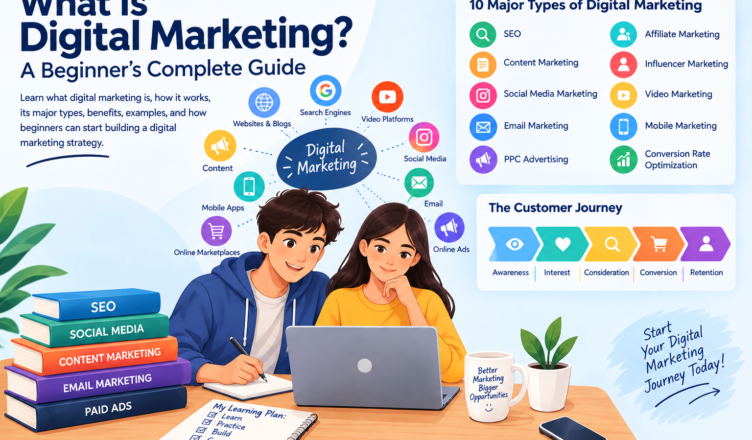
Some common digital channels include:
- Search engines such as Google
- Business websites and blogs
- Social media platforms
- Online advertising
- Video platforms
- Mobile applications
- Online marketplaces
- Content publishing platforms
For example, imagine that you own a small fitness business.
You could create a website explaining your services, publish articles about exercise and nutrition, optimize those articles for search engines, create Instagram content, collect email subscribers, and run online advertisements.
All of these activities can become part of your digital marketing strategy.
The important thing to understand is that digital marketing is not one single activity. It is an umbrella term covering several different marketing methods that work together.
How Does Digital Marketing Work?
A common beginner mistake is thinking that marketing simply means showing an advertisement to someone and asking them to buy.
In reality, effective digital marketing usually involves several stages.
A simple customer journey looks like this:
Awareness → Interest → Consideration → Conversion → Retention
Let’s understand each stage.
1. Awareness
At this stage, a potential customer may not know your business exists.
Your goal is to get attention.
A person might discover your brand through:
- A Google search
- An Instagram post
- A YouTube video
- A blog article
- An advertisement
- A recommendation
- A social media post
2. Interest
Once people discover your business, you need to give them a reason to learn more.
Educational articles, videos, guides, social media posts, and useful resources can help.
For example, someone searching for “how to lose weight at home” might discover a fitness website through a blog post.
3. Consideration
The person now understands the problem and may start comparing different solutions.
They could read reviews, compare prices, visit websites, watch demonstrations, or subscribe to an email list.
4. Conversion
A conversion happens when someone completes a desired action.
That action could be:
- Making a purchase
- Booking a consultation
- Signing up for a newsletter
- Downloading an ebook
- Requesting a quote
- Registering for an event
A conversion does not always mean a sale.
5. Retention
The relationship should not necessarily end after the first purchase.
Businesses can use email, social media, helpful content, customer service, loyalty programs, and other communication methods to encourage customers to return.
This is one reason digital marketing is more than simply advertising. It can support the entire customer journey.
Why Is Digital Marketing Important?
The internet has changed how people discover information, compare products, communicate with businesses, and make purchasing decisions.
Before buying something, people often research their options online.
They may search Google, read reviews, watch videos, visit websites, ask questions on social platforms, or compare different products.
This creates opportunities for businesses to become visible during the customer’s research process.
Another major advantage is measurement.
Traditional advertising can sometimes be difficult to measure precisely. With many forms of digital marketing, businesses can track metrics such as:
- Website visits
- Search traffic
- Click-through rate
- Cost per click
- Leads
- Conversion rate
- Email open rate
- Engagement
- Advertising spend
- Revenue
These measurements can help marketers understand what is working and where improvements may be needed.
10 Major Types of Digital Marketing
There are many specialized areas within digital marketing. Beginners do not need to master all of them immediately, but understanding the major categories will help you see the bigger picture.
1. Search Engine Optimization (SEO)
SEO is the process of improving a website and its content so that it can become more visible in search engine results.
Suppose you search for:
“best running shoes for beginners”
You may see articles, product pages, reviews, and other results.
Businesses use SEO to increase their chances of appearing when potential customers search for relevant topics.
SEO commonly includes:
- Keyword research
- Content creation
- On-page optimization
- Internal linking
- Technical SEO
- Website experience
- Authority building
SEO can be particularly valuable for content-driven businesses because organic search traffic can continue bringing visitors after content has been published.
2. Content Marketing
Content marketing focuses on creating and distributing useful content for a specific audience.
Content can include:
- Blog posts
- Videos
- Guides
- Case studies
- Infographics
- Podcasts
- Tutorials
- Checklists
- Social media posts
Instead of constantly asking people to buy something, content marketing can help answer their questions and build trust.
For example, a company selling accounting software might publish articles about budgeting, bookkeeping, taxes, and financial planning.
3. Social Media Marketing
Social media marketing involves using platforms such as Instagram, Facebook, LinkedIn, TikTok, YouTube, or other relevant networks to communicate with an audience.
Businesses can use social media to:
- Build awareness
- Publish content
- Answer questions
- Develop a community
- Promote products
- Generate leads
- Drive website traffic
The right platform depends on the audience and the type of business.
A B2B company may focus heavily on LinkedIn, while a visual consumer brand may prioritize Instagram or other visual platforms.
4. Email Marketing
Email marketing allows businesses to communicate directly with people who have voluntarily joined their email list.
A business might send:
- Newsletters
- Educational content
- Product announcements
- Special offers
- Welcome emails
- Automated sequences
- Event invitations
Email can be useful because businesses can develop an ongoing relationship with subscribers instead of depending entirely on social media algorithms or search traffic.
5. Pay-Per-Click Advertising
Pay-per-click, commonly called PPC, refers to online advertising models where advertisers pay when users click on an advertisement, although specific advertising platforms can use different pricing models.
Google Ads is a major example.
A business could create an advertisement targeting people searching for a specific product or service.
Paid advertising can generate traffic quickly, but it requires careful budgeting, targeting, creative development, and measurement.
6. Affiliate Marketing
Affiliate marketing is a performance-based model where a person or organization promotes another company’s product or service and may receive a commission when qualifying sales or actions occur.
For example, a blogger might publish a review of a software product and include an affiliate link.
If a reader purchases through that link under the affiliate program’s terms, the publisher may earn a commission.
7. Influencer Marketing
Influencer marketing involves collaborating with creators who have an established audience.
A brand may work with a creator to introduce a product to their followers.
The effectiveness of an influencer campaign depends on factors such as audience relevance, credibility, content quality, campaign objectives, and disclosure practices.
8. Video Marketing
Video is another important part of modern digital marketing.
Businesses can use video for:
- Tutorials
- Product demonstrations
- Educational content
- Customer stories
- Interviews
- Short-form content
- Webinars
Video can make complicated subjects easier to understand and gives businesses another way to communicate their personality.
9. Mobile Marketing
Mobile marketing focuses on reaching people through mobile devices.
Examples include:
- Mobile-friendly websites
- SMS campaigns
- Mobile applications
- Push notifications
- Mobile advertising
Because many people access websites and social platforms through smartphones, mobile experience is an important consideration.
10. Conversion Rate Optimization
Conversion rate optimization, or CRO, focuses on improving the percentage of website visitors who complete a desired action.
For example, imagine that 1,000 people visit a landing page and 30 submit a form.
The conversion rate would be:
30 ÷ 1,000 × 100 = 3%
A marketer might test different headlines, calls to action, page layouts, forms, or offers to understand whether the experience can be improved.
Digital Marketing vs Traditional Marketing
Traditional marketing uses channels such as:
- Television
- Radio
- Newspapers
- Magazines
- Billboards
- Direct mail
Digital marketing uses online and digital channels.
The two approaches are not necessarily opposites. A business can use both.
One significant difference is the level of digital measurement available through many online platforms.
For example, an advertiser may be able to examine impressions, clicks, conversions, audience segments, and advertising costs.
Digital channels can also allow businesses to target particular audiences and adjust campaigns based on performance data.
However, digital marketing is not automatically better for every situation. The appropriate marketing mix depends on the business, audience, objectives, budget, industry, and customer journey.
Benefits of Digital Marketing for Beginners and Businesses
There are several reasons businesses invest in online marketing.
Wider Reach
A website or social media profile can potentially be discovered by people beyond a company’s immediate geographic area.
Audience Targeting
Many advertising platforms provide targeting options based on characteristics and behaviors.
Measurable Results
Businesses can often monitor traffic, engagement, leads, conversions, and other metrics.
Content Longevity
A useful blog article, video, or resource can continue attracting visitors after publication.
Direct Communication
Email and social media provide opportunities to communicate with customers and prospects.
Scalability
A small business can begin with a focused strategy and expand as it learns what works.
A Simple Digital Marketing Example
Let’s imagine a small business selling handmade skincare products.
The business could create a website containing product pages and educational articles.
The marketing system might look like this:
SEO → Blog Traffic → Product Education → Email Signup → Email Sequence → Product Purchase
The business could also use Instagram to publish educational content and product demonstrations.
Paid advertising could introduce selected products to relevant audiences.
After collecting performance data, the business could analyze which channels generate traffic, leads, and sales.
Notice that no single tactic is doing all the work.
The website provides the destination.
SEO brings potential organic traffic.
Content educates visitors.
Social media builds awareness.
Email develops relationships.
Paid advertising can provide additional traffic.
Analytics helps the business understand the results.
This is how the different parts of digital marketing can work together.
How to Start Learning Digital Marketing
If you are completely new, don’t try to learn every platform and strategy simultaneously.
Follow a structured process.
Step 1: Learn the Fundamentals
Start by understanding:
- Marketing basics
- Customer needs
- Target audiences
- Marketing funnels
- Branding
- Basic analytics
Step 2: Choose One Core Skill
Pick one area to study more deeply.
Good starting points include:
- SEO
- Content marketing
- Social media
- Email marketing
- Paid advertising
Step 3: Create a Practice Project
Theory becomes much easier to understand when you apply it.
Create a simple website, blog, social media page, newsletter, or fictional business project.
Step 4: Publish Content
Practice writing articles, creating social posts, producing videos, or building email campaigns.
Step 5: Learn Analytics
Start measuring basic metrics.
For a blog, you might track:
- Organic traffic
- Page views
- Search impressions
- Click-through rate
- Engagement
- Conversions
Step 6: Improve Through Experimentation
Marketing involves testing.
Try different headlines, topics, formats, offers, calls to action, and distribution methods.
Record what happens and use the information to make your next decision.
Common Digital Marketing Mistakes Beginners Make
Learning digital marketing can become much easier when you understand common mistakes.
Trying Every Platform
You don’t need to be everywhere.
Start with channels where your target audience is actually present.
Focusing Only on Followers
A large follower count does not automatically mean a successful business.
Traffic, leads, conversions, customer retention, and revenue may be more meaningful depending on the objective.
Ignoring the Audience
Marketing should begin with understanding the people you want to reach.
Ask:
- What problem are they trying to solve?
- What questions do they have?
- What alternatives are they considering?
- What information would help them make a decision?
Expecting Immediate Results
SEO, content, social media, and audience-building can require consistency and experimentation.
Publishing Without a Strategy
Creating random content can make it difficult to build a recognizable topic and audience.
Instead, create content around clear themes and customer needs.
Not Measuring Results
Without measurement, it becomes difficult to know whether your activities are producing meaningful outcomes.
What Skills Do You Need for Digital Marketing?
You don’t need to be a computer expert to start.
Some useful skills include:
Writing
Clear writing is valuable for blogs, advertisements, emails, landing pages, and social media.
Research
Marketers need to understand audiences, competitors, industries, trends, and customer questions.
Analytical Thinking
You should become comfortable reading data and asking why performance changed.
Creativity
Marketing often requires creating new ideas for content, campaigns, offers, and communication.
Communication
Good communication helps marketers understand customers and explain ideas clearly.
Basic Technical Knowledge
You don’t need to become a developer, but understanding websites, analytics, tracking, content management systems, and advertising platforms can be useful.
Is Digital Marketing Difficult to Learn?
The fundamentals are accessible to beginners, but becoming highly skilled takes practice.
The industry contains many specialized areas, and platforms continually evolve.
The best approach is to learn one concept, apply it, measure the result, and then move to the next concept.
For example:
Learn SEO → research keywords → write an article → optimize it → monitor performance → improve it.
That practical cycle is more useful than simply consuming dozens of courses without implementing anything.
How Long Does It Take to Learn Digital Marketing?
There is no single timeline because the field is broad and people learn at different speeds.
You can understand the basic concepts relatively quickly, but developing professional-level skills requires consistent practice.
A simple learning roadmap could look like this:
Month 1: Fundamentals and marketing strategy
Month 2: SEO and content creation
Month 3: Social media and personal branding
Month 4: Email marketing and conversion optimization
Month 5: Paid advertising and analytics
Month 6: Build and analyze complete campaigns
The objective should not simply be to finish lessons.
The goal is to build enough practical experience to solve real marketing problems.
Frequently Asked Questions
What is digital marketing in simple words?
Digital marketing means promoting a business, product, service, or brand through digital channels such as search engines, websites, social media, email, online advertising, and other internet-based platforms.
What are the main types of digital marketing?
Major areas include SEO, content marketing, social media marketing, email marketing, PPC advertising, affiliate marketing, influencer marketing, video marketing, mobile marketing, and conversion rate optimization.
Is digital marketing suitable for beginners?
Yes. Beginners can start by learning the fundamentals and then developing one skill at a time through practical projects.
Do I need coding skills?
Coding is not required for many digital marketing roles. However, basic technical knowledge can be useful, especially when working with websites, analytics, tracking, and technical SEO.
Can I learn digital marketing for free?
Yes. There are many free educational resources, articles, documentation, videos, and practice opportunities available online. The important part is to combine learning with hands-on practice.
What should I learn first?
Start with marketing fundamentals, customer research, content, SEO basics, analytics, and the concept of the marketing funnel. Once you understand these foundations, you can specialize in a particular channel.
Final Thoughts
Digital marketing can seem complicated because it includes many different channels and skills. But the underlying idea is straightforward: understand an audience, communicate something useful, reach people through appropriate digital channels, and measure what happens.
You don’t need to master everything on day one.
Start with the fundamentals. Learn how customers move from discovering a business to becoming customers. Then choose one area, such as SEO, content marketing, social media, email, or paid advertising, and practice it consistently.
As your knowledge grows, connect the individual skills into a complete strategy.
The most important step is to move from learning to doing.
Create a project. Publish something. Analyze the results. Make improvements. Repeat the process.
That is how beginner knowledge gradually becomes practical marketing skill.
What to Read Next
If you’re building your digital marketing knowledge from scratch, the next logical topic is:
How Digital Marketing Works: From Stranger to Customer
In that guide, we’ll break down the marketing funnel and show how different digital channels work together to move a person from discovering a brand to becoming a customer.
One thought on “1. What Is Digital Marketing? A Beginner’s Complete Guide”