SEO and Digital Marketing: The Complete Beginner’s Guide to Growing Your Business Online
SEO Title: SEO and Digital Marketing: Complete Guide to Growing Your Business
Meta Description: Learn how SEO and digital marketing work together to increase website traffic, attract the right audience, generate leads, and grow your business online.
Suggested URL Slug: /seo-and-digital-marketing-guide/
Primary Keyword: SEO and digital marketing
Secondary Keywords: SEO guide, digital marketing strategy, search engine optimization, online marketing, SEO strategy, digital marketing for beginners
Introduction
Having a website is no longer enough to grow a business online.
Your potential customers are searching for products, services, answers, reviews, and solutions every day. The challenge is getting your website in front of the right people at the right time.
This is where SEO and digital marketing become important.
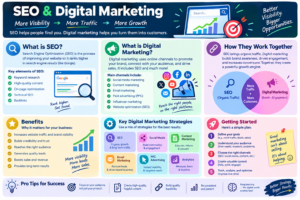
Search Engine Optimization (SEO) helps your website become more visible in search engines, while digital marketing includes a much broader range of strategies such as content marketing, social media marketing, email marketing, paid advertising, conversion optimization, and online reputation building SEO and Digital Marketing
When these strategies work together, they can help businesses attract qualified visitors, build trust, generate leads, and increase sales.
In this guide, we’ll explain what SEO and digital marketing are, how they work together, and how you can create a practical strategy for your website.
What Is SEO?
SEO stands for Search Engine Optimization.
It is the process of improving your website and its content so that search engines can understand your pages and users can find useful information through search.
SEO is not simply about adding keywords to a webpage.
A successful SEO strategy considers several areas, including:
- Understanding what your audience is searching for
- Creating useful and original content
- Optimizing page titles and headings
- Improving website structure and internal links
- Making pages accessible to search engines
- Improving website speed and mobile usability
- Earning relevant and trustworthy links
- Measuring organic search performance
Google’s Search Essentials include technical requirements, spam policies, and best practices that site owners should understand when optimizing for Google Search.
Why Is SEO Important?
SEO can help your business:
- Increase organic website traffic
- Reach people actively searching for your products or services
- Build brand visibility
- Generate qualified leads
- Increase online credibility
- Reduce dependence on paid advertising over time
- Create a long-term source of website traffic
However, SEO should not be treated as a shortcut to instant rankings.
Search engines continuously improve their systems, so the strongest approach is to create a website that genuinely helps its visitors.
What Is Digital Marketing?
Digital marketing is the broader process of promoting a business, product, service, or brand through digital channels.
SEO is one part of digital marketing.
Other major digital marketing channels include:
1. Search Engine Optimization
SEO focuses on earning visibility in organic search results.
2. Content Marketing
Content marketing involves creating useful resources such as:
- Blog posts
- Guides
- Case studies
- Videos
- Infographics
- Tutorials
- Research
- Comparisons
3. Social Media Marketing
Businesses use platforms such as social networks to:
- Build communities
- Share content
- Increase brand awareness
- Communicate with customers
- Drive traffic to their websites
4. Email Marketing
Email marketing can help businesses communicate directly with subscribers through:
- Newsletters
- Product updates
- Educational content
- Offers
- Lead nurturing campaigns
5. Paid Advertising
Paid advertising can provide faster visibility through channels such as search ads, display advertising, social media advertising, and other paid campaigns.
6. Conversion Rate Optimization
Getting visitors to your website is only part of the job.
Conversion optimization focuses on helping visitors take meaningful actions such as:
- Filling out a contact form
- Booking a consultation
- Requesting a quote
- Purchasing a product
- Signing up for a newsletter
SEO vs Digital Marketing: What’s the Difference?
SEO and digital marketing are related, but they are not the same thing.
Think of it this way:
Digital marketing = the overall online marketing strategy
SEO = one important component of that strategy
For example, imagine you own a digital marketing agency.
You could use:
SEO → To attract people searching for digital marketing services.
Content marketing → To educate potential customers through blog posts and guides.
Social media → To distribute your content and build an audience.
Email marketing → To nurture potential customers.
Paid advertising → To reach targeted audiences quickly.
Conversion optimization → To turn website visitors into leads.
Together, these channels create a more complete digital marketing strategy.
How SEO and Digital Marketing Work Together
SEO should not operate in isolation.
A strong digital marketing strategy can support SEO by creating content, building brand awareness, attracting audiences, and generating useful data.
For example:
- You publish an in-depth SEO guide.
- You optimize the page for relevant search queries.
- You share the guide through social media.
- Other websites discover and reference your research.
- People visit your website.
- Some visitors subscribe to your newsletter.
- Your email campaigns continue providing useful information.
- Some subscribers eventually become customers.
This creates a connected marketing ecosystem rather than relying on one traffic source.
10 Important SEO Strategies for Your Website
1. Understand Search Intent
Before creating content, understand what the person actually wants.
For example, someone searching for:
“what is SEO”
is probably looking for educational information.
Someone searching for:
“SEO agency near me”
may be looking for a service provider.
Someone searching for:
“best SEO tools”
may be comparing different products.
These searches have different intentions.
Your content should satisfy the intent behind the search rather than simply repeating a keyword.
2. Create People-First Content
One of the most important principles for modern SEO is creating content primarily to help people.
Ask yourself:
- Does this article answer the reader’s question?
- Does it provide original value?
- Is the information accurate?
- Is the article easy to understand?
- Does it provide practical examples?
- Does it demonstrate real experience where appropriate?
- Would someone find this useful even without search engines?
Google’s guidance emphasizes helpful, reliable, people-first content rather than content created primarily to manipulate rankings.
3. Use Keywords Naturally
Keywords still help search engines and users understand what a page is about.
However, don’t force keywords into every sentence.
For example, instead of writing:
SEO digital marketing is important because SEO digital marketing helps digital marketing businesses with SEO digital marketing strategies.
Write naturally:
SEO is an important part of digital marketing because it can help businesses attract people who are actively searching for relevant products, services, and information.
The second version is easier to read and communicates the topic clearly.
Google specifically identifies excessive or unnatural keyword repetition as keyword stuffing.
4. Optimize Your Title Tag
Your page title helps users and search engines understand the subject of the page.
A good title should:
- Clearly describe the page
- Include the main topic naturally
- Be useful to searchers
- Avoid unnecessary keyword repetition
For this article, a suitable title could be:
SEO and Digital Marketing: The Complete Guide for Beginners
5. Write Useful Meta Descriptions
A meta description summarizes a webpage.
For example:
Learn how SEO and digital marketing work together to increase website traffic, attract qualified leads, build brand visibility, and grow your business online.
A compelling description can help searchers understand what your page offers.
Don’t treat the meta description as a place to stuff keywords.
6. Create a Logical Heading Structure
Use headings to organize your content.
For example:
H1: SEO and Digital Marketing: The Complete Guide
H2: What Is SEO?
H2: What Is Digital Marketing?
H2: How SEO and Digital Marketing Work Together
H2: Important SEO Strategies
H3: Understand Search Intent
H3: Create People-First Content
This makes your content easier for both readers and search engines to understand.
7. Build a Strong Internal Linking Strategy
Internal links connect pages on your own website.
For example, if you publish articles about:
- Keyword research
- Technical SEO
- On-page SEO
- Link building
- Local SEO
- Content marketing
you can connect related articles using descriptive anchor text.
Instead of:
Click here
use something more meaningful, such as:
Learn how to perform keyword research
This helps readers discover related content and creates a more logical website structure.
8. Improve Your Website’s Page Experience
Great content needs a good website experience.
Google’s page-experience guidance recommends looking at the overall experience rather than focusing on one individual metric. Areas to consider include Core Web Vitals, security, mobile usability, intrusive interstitials, excessive advertising, and whether the main content is easy to distinguish.
For a WordPress website, pay attention to:
- Website loading speed
- Mobile responsiveness
- Image optimization
- HTTPS
- Hosting quality
- Plugin usage
- Website navigation
- Readability
- Pop-ups and advertisements
A technically healthy website makes it easier for users to consume your content.
9. Earn Relevant Links
Links from other websites can help people discover your content and can contribute to your site’s authority and visibility.
But don’t treat link building as a numbers game.
Focus on earning links through:
- Original research
- Useful guides
- Industry resources
- Expert insights
- Data-driven content
- Digital PR
- Valuable tools
- High-quality resources
Avoid buying links for the purpose of manipulating rankings or participating in excessive link exchanges. Google identifies these practices as link spam.
10. Measure Your SEO Performance
You cannot improve what you don’t measure SEO and Digital Marketing
Use tools such as Google Search Console and analytics platforms to monitor:
- Organic clicks
- Search impressions
- Search queries
- Click-through rate
- Indexed pages
- Top-performing pages
- Traffic trends
- Conversions
- Technical issues
Don’t judge SEO success only by rankings.
A page ranking highly for an irrelevant keyword may generate little business value.
Instead, connect SEO performance to meaningful outcomes such as qualified traffic, leads, sales, and customer engagement.
SEO Best Practices for WordPress Websites
If you’re using WordPress, your SEO foundation should include several important elements.
Choose a Clean Website Structure
Create logical categories and make it easy for users to move between related pages.
For example:
Website
→ SEO
→ On-Page SEO
→ Technical SEO
→ Keyword Research
→ Link Building
→ Local SEO
This creates a clear topical structure.
Optimize Images
Large images can negatively affect page performance.
Before uploading images:
- Resize them appropriately
- Compress them
- Use suitable modern formats where practical
- Give images descriptive filenames
- Add useful alternative text when appropriate
Don’t use alt text simply as a place to insert keywords.
Keep Your WordPress Website Secure
Use:
- HTTPS
- Updated WordPress
- Updated themes
- Updated plugins
- Strong authentication
- Reliable backups
- Security monitoring
Security is important not only for SEO but also for protecting your visitors and business.
Common SEO Mistakes to Avoid
Many website owners make the mistake of focusing on shortcuts instead of building a useful website.
Here are some practices to avoid.
Keyword Stuffing
Don’t repeat keywords unnaturally throughout your content.
Duplicate or Copied Content
Don’t simply copy content from other websites and republish it.
Add your own experience, analysis, examples, data, or useful perspective.
Low-Value AI Content
Using AI as a writing or research assistant isn’t the same as publishing large amounts of unoriginal content.
Google’s spam policies specifically address scaled content abuse where many pages are produced primarily to manipulate search rankings rather than help users.
Buying Links
Don’t purchase links primarily to manipulate ranking signals.
Creating Pages Only for Search Engines
Every page should have a legitimate purpose for your audience.
Over-Optimizing
SEO should improve the user experience—not make your content sound unnatural.
Can AI-Generated Content Rank on Google?
AI itself isn’t the main issue.
The important question is whether the resulting content provides value.
If you use AI to help with:
- Research
- Brainstorming
- Outlining
- Editing
- Summarizing
- Generating ideas
you should still review the content carefully and add meaningful human input.
Add:
- First-hand experience
- Original examples
- Expert insights
- Unique data
- Case studies
- Accurate references
- Practical recommendations
Publishing hundreds of automatically generated pages with little original value can create SEO problems. Google’s spam documentation specifically warns against scaled content abuse, including large amounts of low-value content produced through automation SEO and Digital Marketing.
The Future of SEO
SEO is changing.
Search engines increasingly provide richer search experiences, including AI-powered features and different ways for users to discover information.
That doesn’t mean traditional SEO is disappearing.
It means website owners need to focus even more on:
- Helpful content
- Strong topical coverage
- First-hand experience
- Clear information
- Technical accessibility
- Brand credibility
- Original research
- Good user experience
Google’s Search documentation continues to evolve, including updates related to AI features and guidance for content creators.
The fundamental principle remains simple:
Create something genuinely useful for the people you want to reach SEO and Digital Marketing
A Simple SEO and Digital Marketing Strategy
If you’re starting from scratch, don’t try to do everything at once. SEO and Digital Marketing

Follow this framework.
Step 1: Define Your Audience
Identify:
- Who are your customers?
- What problems do they have?
- What questions do they ask?
- What products or services do they need?
Step 2: Research Topics
Find topics your audience genuinely cares about. SEO and Digital Marketing
Create content around different stages of the customer journey.
Step 3: Build Topic Clusters
Instead of publishing random articles, create groups of related content. SEO and Digital Marketing
For example:
Main Topic: SEO
Supporting topics:
- Keyword Research

SEO and Digital Marketing Ai - On-Page SEO
- Technical SEO
- Local SEO
- Link Building
- SEO Tools
- SEO Analytics
Step 4: Create High-Quality Content
Make each article useful, accurate, readable, and original.
Step 5: Optimize Your Website
Improve:
- Site structure
- Internal links
- Mobile experience
- Speed
- Security
- Metadata
- Images
Step 6: Promote Your Content
Use appropriate channels such as:
- Social media
- Communities
- Digital PR
- Industry relationships
Step 7: Measure Results
Monitor traffic, search performance, engagement, leads, and conversions.
Step 8: Improve Existing Content
SEO isn’t finished when you publish an article.
Review important pages periodically and update them when information, examples, statistics, or user needs change.
Frequently Asked Questions
Is SEO part of digital marketing?
Yes. SEO is one component of digital marketing. Digital marketing also includes content marketing, social media marketing, email marketing, paid advertising, conversion optimization, and other online channels SEO and Digital Marketing
How long does SEO take to work?
There is no universal timeframe. Results depend on factors such as the website’s existing authority, competition, technical condition, content quality, search demand, and the work being implemented SEO and Digital Marketing
SEO should generally be treated as a long-term marketing channel rather than an overnight strategy SEO and Digital Marketing
Is SEO free?
Organic search traffic does not require paying Google for every click, but SEO isn’t necessarily free. Businesses may invest in content creation, SEO tools, technical improvements, specialists, research, and promotion.
Is keyword research still important?
Yes, understanding the language and questions used by your audience can help you create relevant content. However, keywords should be used naturally rather than stuffed into pages SEO and Digital Marketing
Can a new website rank on Google?
Yes, new websites can appear in Google Search. However, how quickly pages gain visibility varies considerably depending on the topic, competition, site quality, content, and other factors.
Should I focus on SEO or social media?
You don’t necessarily need to choose one.
SEO can help capture existing search demand, while social media can help build awareness, relationships, and content distribution.
The appropriate mix depends on your audience and business objectives.
Final Thoughts
SEO and digital marketing are not about finding a secret trick that guarantees a #1 ranking.
A sustainable strategy starts with understanding your audience and creating something genuinely useful for them.
Focus on: SEO and Digital Marketing
People → Useful Content → Strong Website → Promotion → Measurement → Continuous Improvement
If you consistently publish valuable content, maintain a technically sound website, understand your audience’s needs, and avoid manipulative SEO practices, you create a much stronger foundation for long-term organic growth.
The goal isn’t simply to get more visitors.
The goal is to attract the right visitors and give them a reason to trust your brand.
2 thoughts on “seo and digital marketing”