
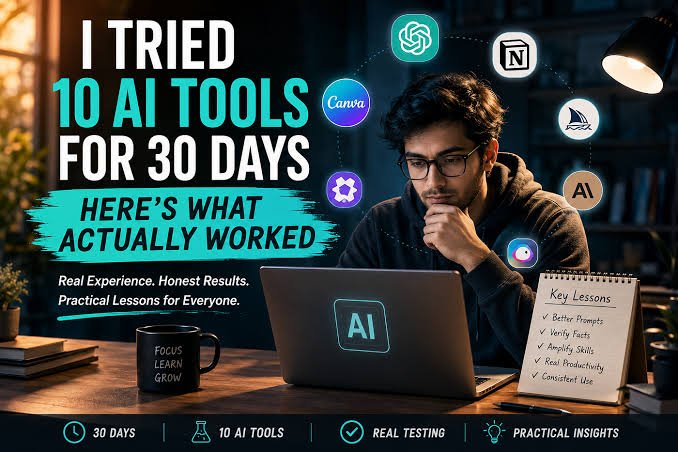
I Used AI for 30 Days — Here’s What I Learned
What happens when you use AI every day for an entire month?
That was the question I wanted to answer.
Instead of using AI only when I needed a quick answer, I decided to make it part of my daily routine for 30 days. I used AI for learning, writing, brainstorming, research, planning, and everyday productivity.
At first, it felt like I had discovered a shortcut for almost everything.
But after 30 days, I realized something more important:
AI isn’t a replacement for thinking. It’s a tool that can make your thinking more effective.
Here are the five biggest lessons I learned.
1. AI Is Better at Helping Than Doing Everything
At the beginning, I made the mistake of asking AI to do complete tasks for me.
Need an article? Generate it.
Need ideas? Generate them.
Need an explanation? Give me the answer.
It was fast—but I wasn’t always learning anything.
After a while, I changed my approach.
Instead of saying:
“Write this for me.”
I started asking:
“Help me create an outline.”
Instead of:
“Solve this problem.”
I asked:
“Give me a hint and explain the concept I need to understand.”
That small change made AI much more useful.
The lesson: Use AI as a collaborator rather than a replacement for your own effort.
2. Better Prompts Produce Better Results
During the first few days, my prompts were extremely simple.
I’d ask:
“Give me blog ideas.”
The results were okay, but often generic.
Then I started giving AI more context.
For example:
“Give me 10 blog ideas about AI for college students. Focus on practical topics that beginners can understand. Each idea should solve a specific student problem.”
The difference was obvious.
I learned that AI responds much better when you explain:
- What you want
- Who it’s for
- Why you need it
- The tone or style
- The format
- Any limitations
The lesson: Learning how to communicate with AI is a real skill.
3. AI Can Save a Lot of Time
One of the biggest benefits I noticed was speed.
Tasks that normally required significant effort could often be started much faster with AI.
For example, I could use AI to:
- Brainstorm ideas
- Create outlines
- Summarize long information
- Rewrite unclear sentences
- Generate questions for practice
- Organize information
- Create checklists
- Explain unfamiliar concepts
But there was an important catch.
AI helped me get to a first draft faster.
It didn’t automatically produce the final answer.
I still needed to review, edit, fact-check, and improve the result.
The lesson: AI is excellent at reducing the time between a blank page and a useful starting point.
4. AI Makes Learning More Interactive
This was probably the biggest surprise.
Instead of simply reading about a topic, I could have a conversation about it.
For example, if I didn’t understand a concept, I could ask:
“Explain this in simple language.”
Then:
“Give me an example.”
Then:
“Now test me.”
Then:
“Explain why my answer is wrong.”
This creates a learning experience that feels much more interactive than simply reading a textbook.
AI can adjust its explanation based on your questions.
The lesson: AI can be a powerful study partner when you use it to understand concepts rather than simply obtain answers.
5. AI Can Be Wrong
This was the most important lesson of the 30 days.
Sometimes AI sounded completely confident even when the information wasn’t correct.
That taught me something important:
Confidence doesn’t equal accuracy.
I started checking important information instead of automatically trusting the response.
For research, assignments, statistics, technical information, and other important topics, I learned to verify information using reliable sources.
This is especially important when AI provides:
- Statistics
- Quotes
- References
- Historical facts
- Scientific claims
- Legal or financial information
The lesson: AI should be questioned, not blindly trusted.
What Changed After 30 Days?
After using AI regularly, I noticed that I wasn’t simply getting answers faster.
I was becoming better at breaking problems into smaller pieces.
Instead of thinking:
“I don’t know how to do this.”
I started thinking:
“What part of this problem do I understand, and what part do I need help with?”
That change was surprisingly valuable.
AI became less like a search box and more like a thinking partner.
The Biggest Mistake I Made
My biggest mistake was trying to use AI for everything.
There’s a temptation to automate every difficult task.
But sometimes struggling with a problem is exactly how you learn.
If AI immediately gives you the solution every time, you can miss the opportunity to develop your own skills.
Now, I try this process:
Think → Try → Ask AI → Check → Improve
Rather than:
Ask AI → Copy → Finish
The first process takes a little more effort, but you learn much more.
Would I Recommend Using AI Every Day?
Yes—but with one condition.
Use it intentionally.
Don’t use AI just because you can.
Use it when it helps you:
- Understand something
- Explore ideas
- Save time
- Improve your work
- Practice a skill
- Organize information
- Find better ways to solve problems
And always keep your own judgment involved.
Final Thoughts
After 30 days of using AI, my biggest takeaway wasn’t that AI can do everything.
It’s that AI can make